OWU Slocum Hall Front Entrance Improvements
Delaware, Ohio
WHY
Slocum Hall was built in 1898 as the primary library on the Ohio Wesleyan University campus and is listed on the National Register of Historic Places. The building is located in the center of the campus and contains the iconic ‘Reading Room’ which is punctuated by a 70’ x 20’ leaded glass ceiling. The building has changed uses over time and is now used primarily as administrative offices and a visitor center.
The building was not ADA Accessible at the front entrance, and this project created ADA accessibility while maintaining the architectural integrity of the principal facade of the building.
HOW
Designing Local worked with the project architect to examine the existing features of the front portico. The preferred design solution included raising the existing landing up to the height of the existing door threshold and constructing new stone stairs around the west and north sides of the portico. The south side included a ADA accessible ramp to access the new landing. A kneewall will help to minimize the visual impact of the ramp, and the materials of the wall itself match the stone type and detailing of the historic building facade. There are numerous additional minor site improvements included in the project including new planting beds, small areas of pavement replacement, and screening of utility areas.
WHAT
The project was initially scheduled to bid in Spring 2020, but the Covid-19 pandemic paused the project for over a year. The project was bid in Spring 2021 and construction was completed in Autumn 2022.
Akron Cultural Plan
ArtsNow | Akron, Ohio
WHY
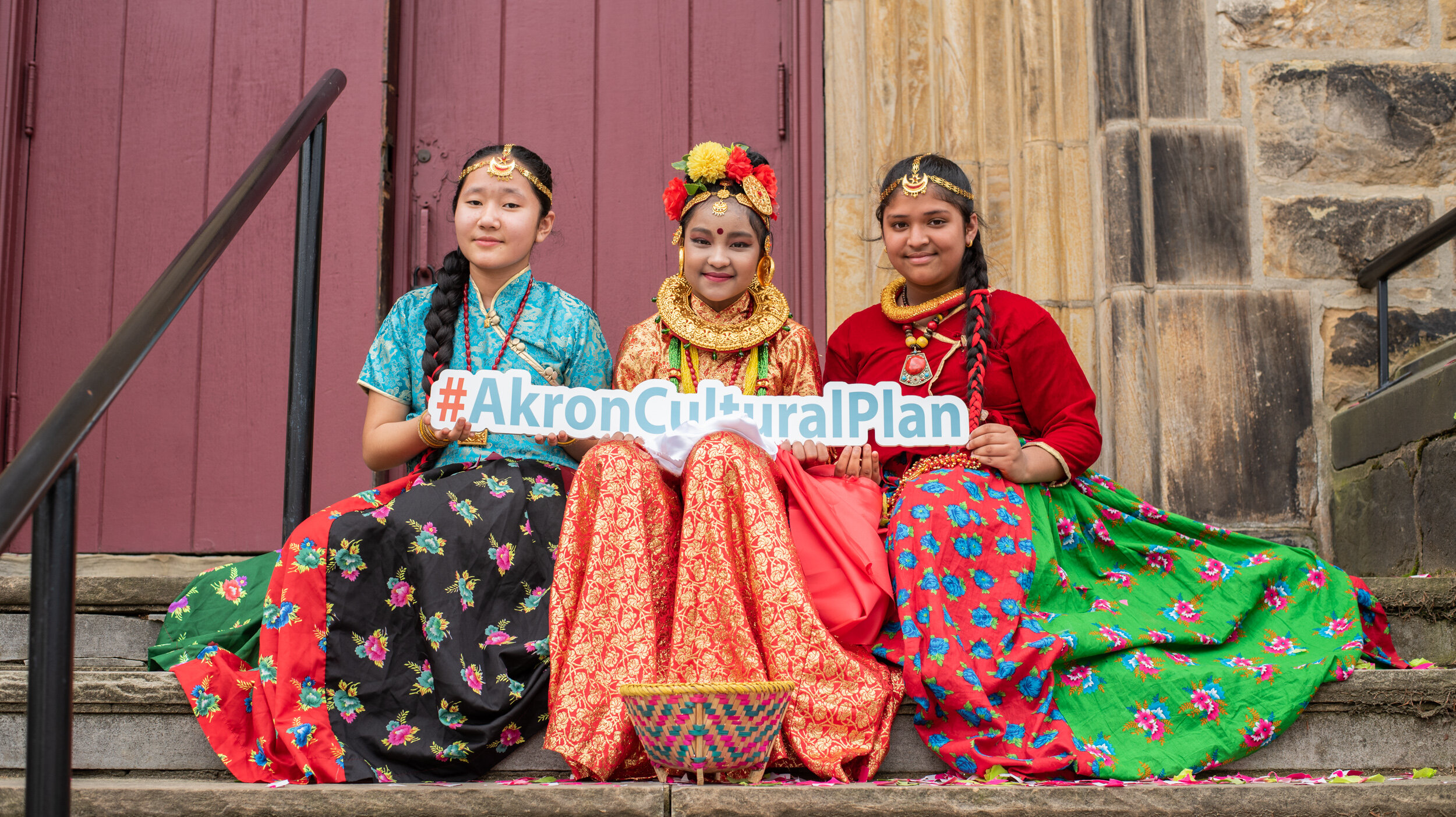
The Akron Cultural Plan is a culmination of more than five years of work by the City of Akron, along with its partners ArtsNow, the GAR Foundation, and the John S. and James L. Knight Foundation. The plan seeks to build upon past studies of Akron’s cultural landscape to help the community grow and prosper, with arts and culture at the center of the city’s renaissance.
HOW
Extensive public and stakeholder engagement revealed themes of access, equity, parity, and more. Initial recommendations focused on creating more inclusive creative leadership in Akron and creating access for all.
WHAT
Work on the plan began in early 2019 and was completed in March 2020. Recommendations fell into 10 priority areas: Equity, Accessibility, Education, Talent, Engagement, Connections, Economic Impact, Resources, Placemaking, and Public Art. The planning team continues to assist with ongoing implementation of the Akron Cultural Plan and the Akron Public Art Program.
Why a Cultural Plan?
As part of the Cultural Plan, the team created a
series of videos from community members to
encourage participation throughout Akron. Here
are a few of our favorites. Check out more videos
on our YouTube page!
Art for All Public Art Master Plan
Fort Wayne, Indiana
WHY
The City of Fort Wayne, Indiana recently adopted an ordinance requiring any private development receiving TIF incentives to contribute 1% of the project fee to the City of Fort Wayne’s Public Art Fund. In an effort to invest these dollars responsibly, the city set out to create a Public Art Master Plan. The plan would direct spending to high-priority projects in downtown and neighborhoods, and outline the infrastructure necessary to create a robust public art program.
HOW
Designing Local held more than 100 stakeholder interviews to kick off the plan’s discovery phase, and hosted a Public Art Pecha Kucha event to initiate the planning process. Six local artists and a nationally recognized curator spoke about the power of public art to a standing-room audience of 250 people. The team hosted a series of meetings titled ‘Public Art Popsicle Pop-Up on a Parklet’ to co-create big ideas for public art in the community. We also developed a custom map program through which participants could select where public art should go, where special stories happen, and where public art currently exists.
WHAT
Through the development of sound policy and an implementation framework, the Fort Wayne Public Art Master Plan offers the city an opportunity to create public art that is uniquely Fort Wayne.
Downtown Douglasville Public Art Master Plan
Douglasville, Georgia
WHY
The City of Douglasville has determined that its future will be one with public art at its center — both physically, in the core area of downtown, and also at the core of its community identity. The Downtown Douglasville Public Art Master Plan laid out a vision for public art in the city’s center, along with strategies to expand that vision throughout the entire Douglasville community.
HOW
Designing Local created a strategy for the growth of public art in Douglasville, in ways that are transformational, adventurous, and embody the spirit of the city and its residents.
WHAT
The Downtown Douglasville Public Art Master Plan is just the first step. Its execution ensures that Douglasville remains a leader in the region and signals to residents, visitors, and artists that Douglasville is a hub of arts and culture in West Georgia. With a storied past and a strong vision for the future, great things are in store for Douglasville.
Upper Arlington Arts & Culture Master Plan
Upper Arlington, Ohio
WHY
The City of Upper Arlington has one of the oldest arts and culture programs in Central Ohio. Housed within the Parks & Recreation Department, its Cultural Division is advised and supported by the Cultural Arts Commission, a seven-member group appointed by City Council for the purpose of fostering and encouraging the development and preservation of arts in the community. As part of this charge, the Commission recognized the need for a clear and thoughtful master plan to guide the future of cultural arts in the City of Upper Arlington.
HOW
The yearlong process of developing the master plan kicked off in the fall of 2018, beginning with a general study of the history and current state of the arts in Upper Arlington. This research was followed by an extensive 6-month community input process that included more than 1,000 one-on-one touch points in the form of surveys, focus group meetings, and pop-up events held throughout the city. The feedback received from this public engagement demonstrated the community’s support for the Division’s programs, as well as support for continued investment in the arts.
WHAT
The Arts and Culture Master Plan established a series of short-, mid-, and long-term implementation strategies that focused on enhancing existing programming, strengthening operations, and raising awareness of the arts and culture opportunities available to residents. It provided clarity on the purpose, roles, and responsibilities of the Cultural Arts Commission, and set forth an inspirational guiding framework for exploring expanded public art opportunities in the community. The plan was accepted by Council in December 2019.
Cape May County Creative Placemaking Plan
Cape May, New Jersey
WHY
In 1989, Cape May County initiated a taxpayer-funded program to purchase or protect open space and farmland throughout the County. The program proved successful and was eventually expanded to include funding of parks, recreational amenities, and historic preservation projects. While the program has been extremely successful in meeting its mission, it has relatively low public recognition.
HOW
To build awareness of the program and to increase the quality of funded projects, the County initiated a Creative Placemaking Plan which created a brand identity, standards for park design elements and amenities, and a demonstration site design. Designing Local was selected through a competitive process to lead the creative placemaking plan. The team facilitated four total workshops to garner input from key stakeholders and to develop and test ideas.
WHAT
A key part of the process was the creation of a community character framework which defines the unique sense of place present in Cape May County. This was utilized to drive the creation of the brand identity guidelines. The community character framework was also utilized in the design of various signage, site amenity, and architectural concepts throughout the County.
Chamblee Arts Master Plan
Chamblee, Georgia
WHY
Chamblee, a small Dekalb City wedged between Doraville and Brookhaven in metro Atlanta, is home to innovators, business owners, entrepreneurs, artists, and community members who envisioned more creativity in the public realm. Public Art provides a unique opportunity to elevate Chamblee’s identity as a unique community that cares about investment in arts and culture.
HOW
Informed by the initial stakeholder interviews, a series of focus groups were held with local artists and arts leaders, as well as with residents and business owners, A series of community events were held to gather information about the public’s vision for the arts in Chamblee. The Arts Master Plan outlines future investment in the arts, as the arts will play a major role in maintaining Chamblee’s authenticity while celebrating its future as an inclusive and culturally vibrant place in which everyone can find a place to belong.
WHAT
This plan was designed to be organic - it will evolve as the City grows and changes. The investments made as a result of this plan will vary in size and scale, but a throughline of intentionality will run throughout. In the City of Chamblee investments in the arts will follow the guidelines outlined in Arts Plan document, ensuring a future where arts and culture reflect the people and their future focused, clear-eyed vision of livability, prosperity, and access.
Dublin Arts Center Event Terrace & Cabin Reconstruction
Dublin, Ohio
WHY
This project will significantly enhance the aesthetics and functionality of the Dublin Arts Center. The building was constructed as a private residence and includes a 6 acre site along the east bank of the Scioto River. Designed in a French-Eclectic architectural style and built in 1941, the site is listed in the National Register of Historic Places. The City of Dublin purchased the property in 1999.
This project will improve the rear grounds of the building with the addition of an event terrace, various site features, landscape lighting, electrical service for events, a historic log cabin reconstruction, and a connecting path to the Scioto River.
HOW
The site has over 70’ of grade change from the rear entrance of the building to the Scioto River. This presents a challenging design and engineering problem in which cost-effective ADA-compliant site circulation and stormwater management are key drivers of the design process. It also generates opportunities for incredible vistas and dramatic event spaces. Designing Local developed three site plan alternatives which demonstrated how the vertical and horizontal location of the event terrace will influence the overall feel and functionality of events. The construction materials reflect historic character of the existing building.
WHAT
The project is currently in construction.
Pinellas Park Public Art Plan
Pinellas Park, Florida
WHY
As the physical heart of Pinellas County, the City of Pinellas Park has grown into a uniquely open, accessible community. There were great opportunities to enhance the community’s identity with residents and neighbors in the region. A key priority of the public art programming in Pinellas Park was to help create an ecosystem of artists, creatives, performers, and consumers. Past efforts have encouraged artists to locate within the Arts Village, creating opportunities for artists to showcase their art and patrons to enjoy and purchase it. The public art program was needed to help expand the art ecosystem in the city by creating new opportunities for artists and visitors to experience art.
HOW
Focusing on the future was a key perspective of the planning team. The plan was not created just for today but also creates an impactful, sustainable public art program for the future. This program was developed to outlast those involved in this process in order to create solid deliverables for years to come. The community engagement efforts that were undertaken as part of the planning process were key to developing not only the vision and priorities for public art, but also the ideas that will help ensure public art becomes a beacon for residents and visitors in Pinellas Park. Engagement efforts included a large-scale survey, as well as in-person engagement at a number of events.
WHAT
The foundation of the Pinellas Park Public Art Plan rests on four pillars: community engagement, stakeholder feedback, best practices, and a forward focus. Step by step, the City of Pinellas Park will be able to formalize, initiate, and fund a public art program that will have a lasting impact on the city. The program is governed by transparent procedures that ensure it is efficient and effective. A variety of funding mechanisms to ensure program sustainability were also presented.
Sandusky Public Art & Placemaking Plan
Sandusky, Ohio
WHY
The City of Sandusky is a hidden gem that is seeing significant new investment and cutting-edge planning. Sensing an opportunity to increase attachment to place and draw new tourists, city leaders passed a public art ordinance in January 2018 that guarantees funding for public art through a 1% allocation of their general fund. To ensure they invested the newly earmarked public art dollars responsibly, the city set out to develop a Public Art and Placemaking Plan. The plan directs spending to high-priority projects and creates the infrastructure necessary to administer a robust public art program.
HOW
Designing Local organized a public art popsicle pop-up to kick off the planning process, at which participants were asked their vision for public art in the city and to think about potential transformative projects. The team hosted several additional meetings to co-create ideas for the City’s first projects. In addition to developing placemaking strategies, the team trained Sandusky’s newly formed Public Art and Cultural Commission on procurement processes for public art, collection management and maintenance, and donations.
WHAT
The Sandusky Public Art and Placemaking Plan inspires elected officials to create public art strategies that are uniquely Sandusky. With an efficient and effective process for public art, the city now has the tools to ensure a successful program well into the future.
Frisco Public Art Master Plan Update
City of Frisco, Texas
WHY
In 2002, the City of Frisco developed a public art program at a pivotal moment in its history. With a population of just over 50,000 residents and a unique position in the North Texas Region, the city was poised for explosive growth, culminating with an anticipated population of just over 350,000 by 2035. In 2004, the city adopted a Public Art Master Plan and, since then, commissioned more than 75 pieces totaling $4+ million. In 2018, Frisco sought to update its Public Art Master Plan to include strategies for managing its burgeoning collection.
HOW
Designing Local evaluated the city’s collection and conducted public engagement sessions to formulate recommendations for an updated plan.
WHAT
The Frisco Public Art Master Plan Update was adopted in August 2018, providing the city a roadmap to integrating thoughtfully curated public artworks into their capital projects through 2023. With a Collection Management Policy in place, the city can better care for its current collection as it adds new pieces.
Montpelier Public Art Master Plan
Montpelier, Vermont
WHY
When the City of Montpelier, Vermont began collaborating with a private developer for a redevelopment project, they wanted to pursue an innovative approach. The project, supported by local, state, and federal funds, was Montpelier’s largest private-to-public development in 30 years. One Taylor Street, which is being called the new gateway to Montpelier, has catalyzed other design and community development projects. The city was awarded an Our Town grant from the National Endowment for the Arts to express community values and vision through public art at One Taylor Street.
HOW
The centerpiece of the planning process was a series of five creative visioning workshops led by teaching artists from different disciplines. These hands-on workshops were led by community members to express their vision for how art can enhance community and sense of place. Each workshop was capped off by a public event to exhibit the creative visioning works, with audience reflection time to gather input for the master plan.
WHAT
The creative visioning workshops culminated in a Master Plan and the installation of Montpelier’s first major city-funded public art work. The artwork — done by a Vermont artist and selected by a jury — was installed at the One Taylor Street Redevelopment Project in 2019.
Art on High Strategic Plan & Artist Selection
Columbus, Ohio
WHY
In 2010, the City of Columbus, Ohio dedicated $25 million to the High Street Streetscape Project, which will transform North High Street through the Short North Arts District and the southern University District — one of the busiest corridors in Columbus. The streetscape improvements will create a safer, more walkable, and more inclusive neighborhood by burying overhead utilities, increasing sidewalk widths, standardizing streetscape elements, upgrading lighting, adding marked crosswalks, improving stormwater management, and adding new street trees. Two percent of the total streetscape budget has been dedicated to an investment in public art.
HOW
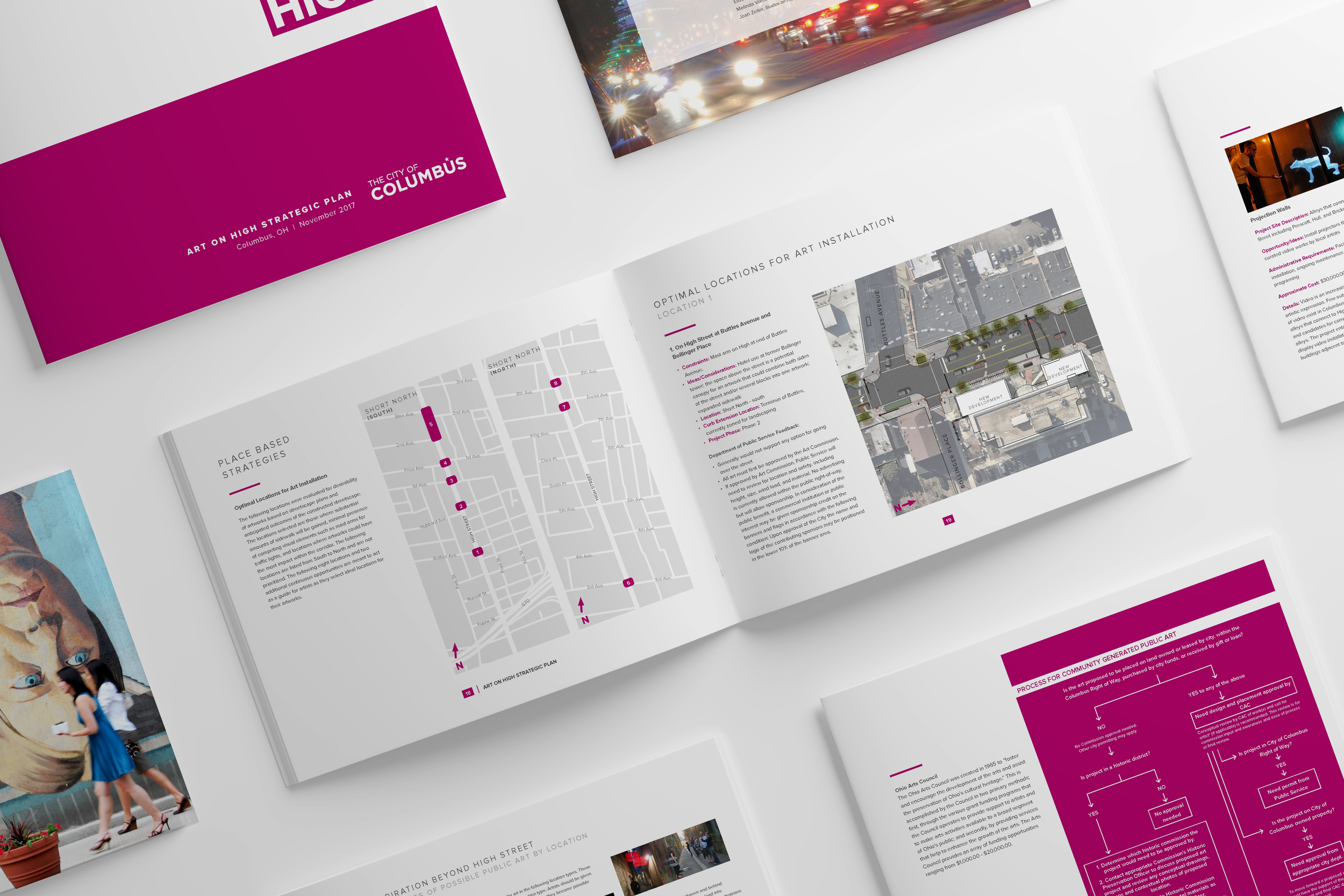
Designing Local advised the City of Columbus as it planned for its public art investment, and managed a team of three consultants. Through extensive public engagement and a thorough understanding of the current and future built environment, Designing Local selected eight locations at which to site public art along a two-mile stretch of North High Street. Each location was vetted by the Columbus Department of Public Service and the design team to ensure it would be suitable for public art.
WHAT
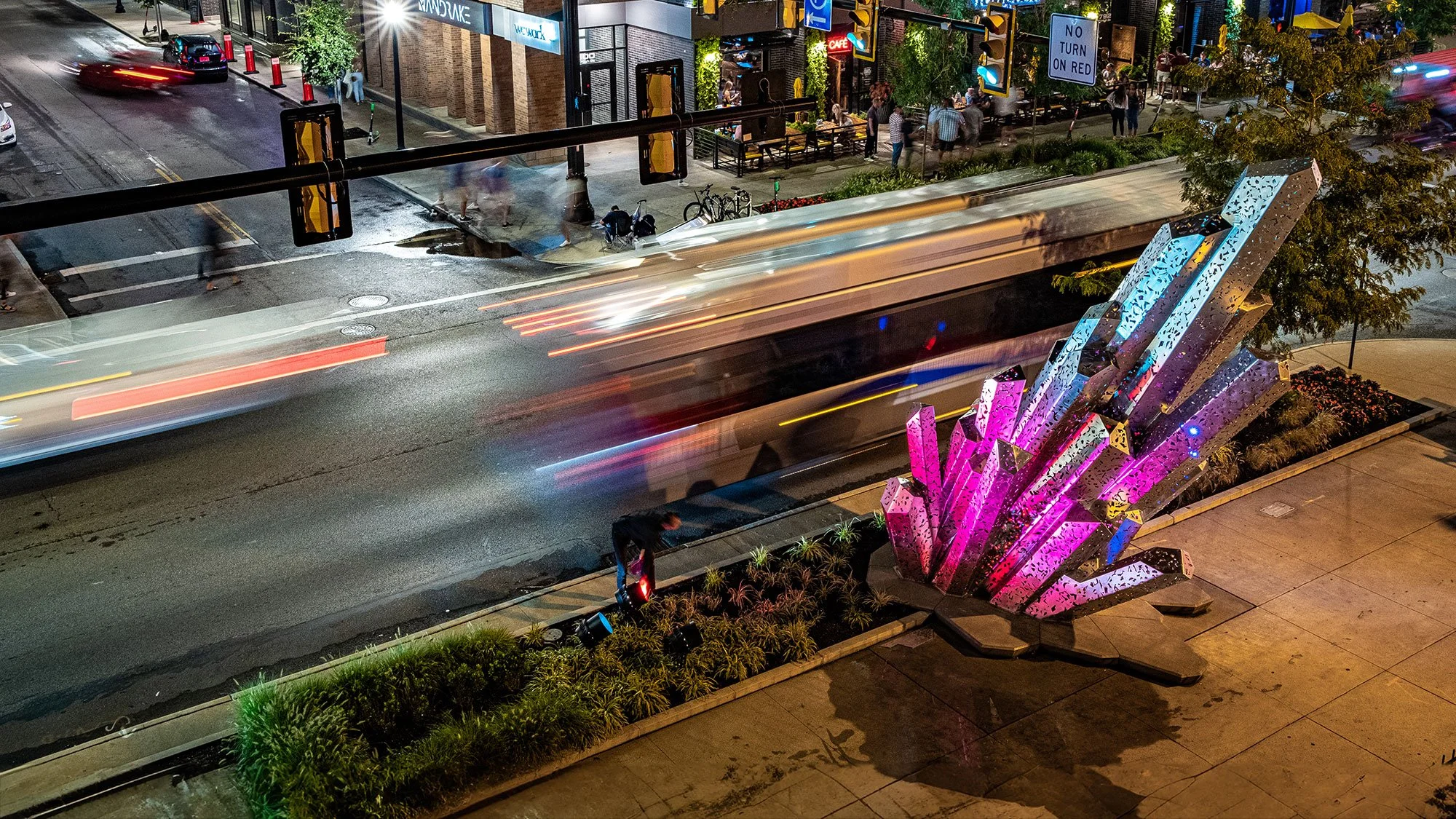
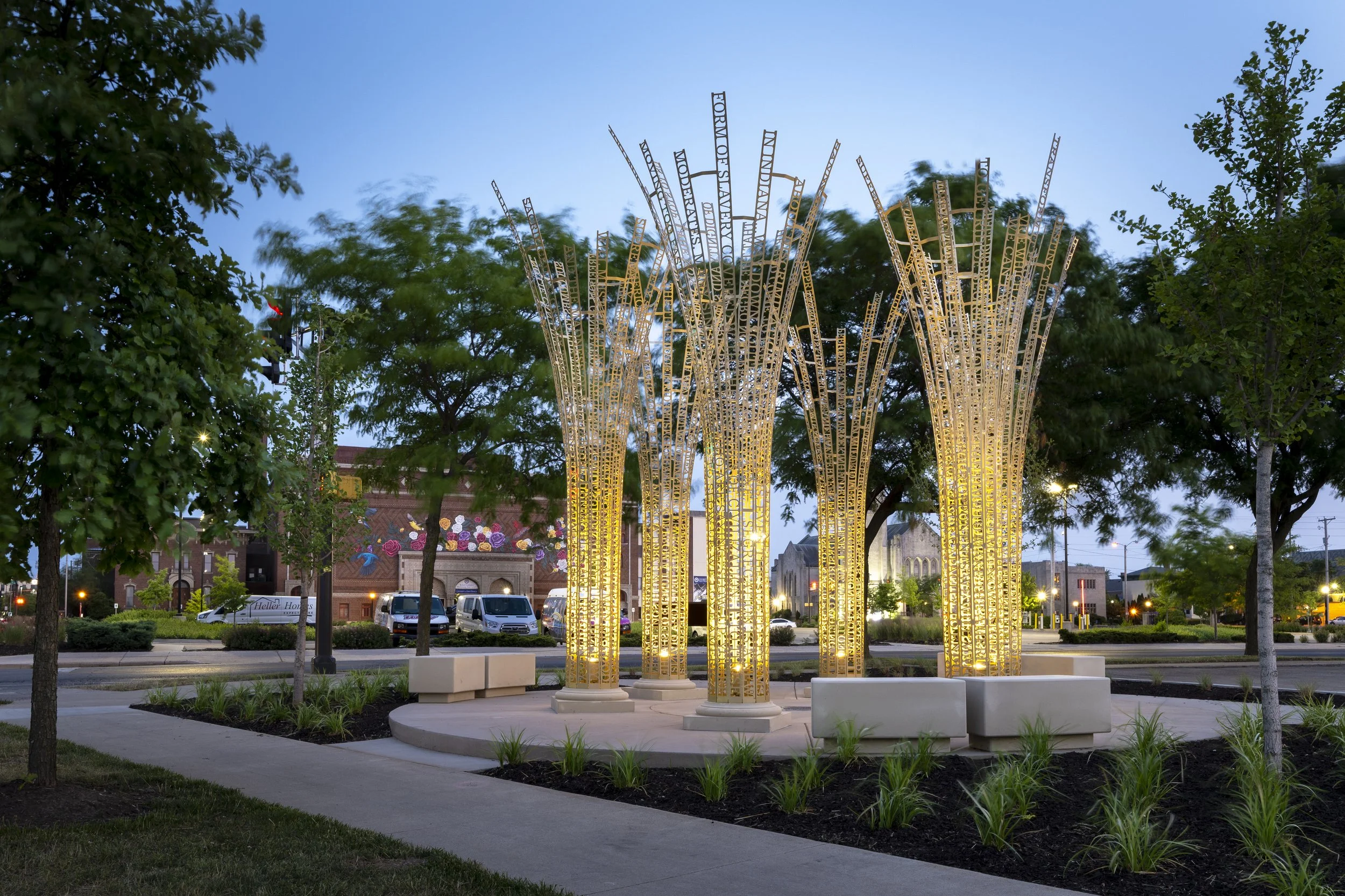
The Art on High Strategic Plan provided a vision for how public art should be featured along the corridor, and how this initial investment could be used to catalyze future such investment. In addition, the team conducted three public meetings, monthly walkabouts, and extensive stakeholder interviews to determine what the community would like to see on the site. Designing Local then managed a call for artists and jury process, from which artist Mark Reigelman was selected. His ‘Makers Monument’ was installed in July 2021.
Surprise Arts & Culture Master Plan
Surprise, Arizona
WHY
Surprise, Arizona is a city in the West Valley of the Phoenix Metro Region whose leaders are looking to arts and culture to help define their vast and growing metro area. Current plans forecast that by 2050, today’s 125 square miles will expand to 400+, and today’s 125,000 residents will increase to 500,000. This projected growth provides an opportunity for the city to proactively ensure new development is interspersed with arts and culture reflecting the city and its people.
HOW
Great care was paid to integrating the Public Art Master Plan with other planning efforts, such as the Park and Recreation Master Plan, to ensure that it could be easily implemented alongside others as the city grows and develops. Due to the large scale of the population and land area, the team focused on making public engagement accessible and diverse. From baseball spring training to public art bus tours, the team provided interesting engagement opportunities that met the needs of a community whose population includes large numbers of young families and retirees.
WHAT
The Surprise Public Art Master Plan covers topics ranging from recommendations on how to bring more publicly- and privately-supported public art to the city to encouraging the development of large-scale cultural venues. The plan helps solidify the role of art and culture in the future of Surprise.
University District Arts & Character Plan
University District Organization | Columbus, Ohio
WHY
“Time” and “change” aren’t just words in The Ohio State University’s alma-mater, they are words that perfectly capture the University District neighborhood. As the ever-evolving place transitions into another new era, long-term residents and businesses want to ensure the spirit of the community lives on for the next generation. The University District Organization took action to ensure that new buildings had ample public art offerings and new residents had myriad opportunities to engage with the arts.
HOW
A diverse community necessitates diverse engagement. In the University District, this meant targeted outreach to artists and performers through Music, Visual Arts, Culture, and History workshops hosted at various music, art, and poetry venues. Additionally, residents, students, and others who cared about the neighborhood were provided online and in-person opportunities to share ideas about how its spirit could be better reflected in the built environment.
WHAT
The University District Arts and Character Plan generated targeted recommendations to add public art to the neighborhood and bolster existing performing arts and music venues. A ‘Music Trail’ concept modeled on other successful marketing efforts — but with an artistic twist — will help drive attendance to existing music venues. Additional recommendations include specific locations for art pieces to be added, as well as possible future art trails and installations.
Plain City Survey on the Future
Plain City, Ohio
WHY
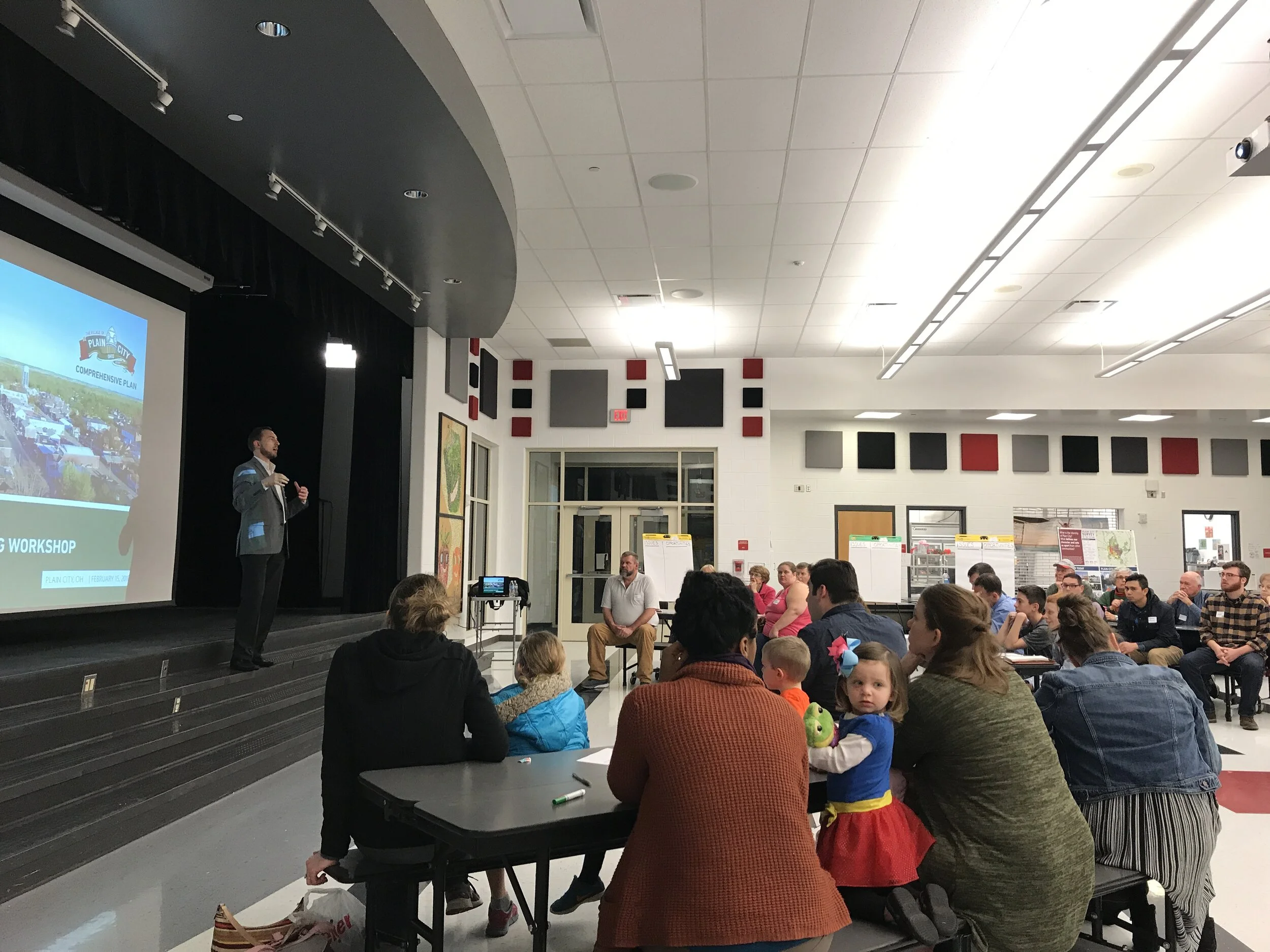
Plain City’s Comprehensive Plan Committee wanted to survey residents and other community stakeholders to uncover their vision for the village’s future and establish a baseline of their opinions to help shape the Plain City Comprehensive Plan.
HOW
Designing Local worked to gain widespread community participation in the ‘Survey on the Future’ by distributing business cards about it at the 4th of July and Steam Threshers parades and posting door tags on homes throughout the village. More than 600 village residents and 400 other stakeholders ultimately took the survey — a far greater response than had previously been achieved.
WHAT
The results were compiled into a ‘Survey on the Future’ final report, which was presented to Council and also released to the public.
Plain City Community Plan
Plain City, Ohio
WHY
Plain City was a community at a crossroads. The village celebrated its Bicentennial in 2018 and achieved ‘city’ status in 2020; it is anticipated that the next 30 years will bring it significant residential and commercial growth. Plain City is a community that cherishes its history and small town feel so, in order to guide the growth that is sure to come, the village undertook a comprehensive planning process.
HOW
The yearlong project began with a community engagement process that built on Designing Local’s previous surveying efforts. Through community engagement, we identified historic preservation and the revitalization of Uptown Plain City as vitally important to residents and other stakeholders.
Designing Local led the historic preservation portion of the planning process, and subsequent recommendations. As part of the process, we inventoried historic buildings in the Uptown area to assist in future National Register nominations and identify significant buildings and collections of buildings for the plan.
WHAT
The 2018 Bicentennial Community Plan is a Comprehensive Plan for Plain City will guide development and decision-making there for the next 10 to 20 years.
Los Altos Public Art Master Plan
Los Altos, California
WHY
For more than 25 years, the City of Los Altos, in the heart of Silicon Valley, has boasted a thriving public art program. As of 2017, their collection featured more than 35 pieces that had either been purchased by the city or were part of the Sculpture on Loan program. The Arts Commission and Council at the time decided a Public Art Master Plan was necessary to further enhance their city’s identity and sense of place.
HOW
Because Los Altos is populated by highly tech-oriented residents, public engagement activities included a project website and an online survey, coupled with an open house and community discussion with a public artist who presented her method for creating site-specific work.
WHAT
The Los Altos Public Art Master Plan focused on developing funding strategies and conceptual projects and programs, as well as public art maintenance and gifting policies.
Roswell Public Art Master Plan
City of Roswell, Georgia
WHY
Roswell, Georgia was at a crossroads. As a historic community in the fast-growing Atlanta region, Roswell was determined to embrace its historic past while showcasing its emerging identity through new development. City leaders here desired a unique process for engaging with residents and businesses that would help build support for public art in the future.
HOW
In Roswell, public engagement took many interesting and unusual forms. It was especially important, given its fractured political environment, to engage and education a representative array of stakeholders. From local breweries — which even concocted a small batch ‘Roswell Arts Fund’ beer — to high school classrooms, the team focused on meeting people where they were. Through this targeted outreach, we were able to ensure that all factions of the community were engaged in and supportive of the final plan.
WHAT
The Roswell Public Art Master Plan was adopted in July of 2017. It focused on two key strategic goals: prioritization of art types and sites, and public education for future policy changes (i.e., a 'percent for the arts’ ordinance).
San Luis Obispo Public Art Master Plan
San Luis Obispo, California
WHY
San Luis Obispo’s vision for public art stems from a long legacy of public art champions and more than 25 years of investment in the arts at a citywide level. In 1990, the city established and funded a public art program by requiring that 1% of the estimated construction cost of eligible projects in the Capital Improvement Plan be set aside for public art. To build upon their strong legacy of public art and cast a vision for the next 25 years, the city decided to seek community input in 2016.
HOW
To kick off the planning process, stakeholders were asked a series of questions about how public art relates to their sense of place, to the overall identity of San Luis Obispo, and to economic growth, business development, education, downtown development, and community engagement. They were then asked to consider where new pieces of public art should go and what types of art they would like to see in their community. They also discussed attributes that make San Luis Obispo stand out among other Central Coast communities, California communities, and the rest of the United States. In addition to the three public meetings, engagement opportunities also took place at an elementary after-school program, during a middle school lunch break, and during regularly scheduled San Luis Obispo High School art classes. An online survey was conducted to capture the ideas of those who were unable to attend the workshops in person.
WHAT
The Public Art Master Plan was adopted by City Council in December 2016. Recommendations from the plan include increasing Art in Public Places funding, developing a full time Public Art Manager position within the Parks and Recreation Department, and developing a maintenance and conservation plan.