Reimagining Columbus
Columbus, Ohio
WHY
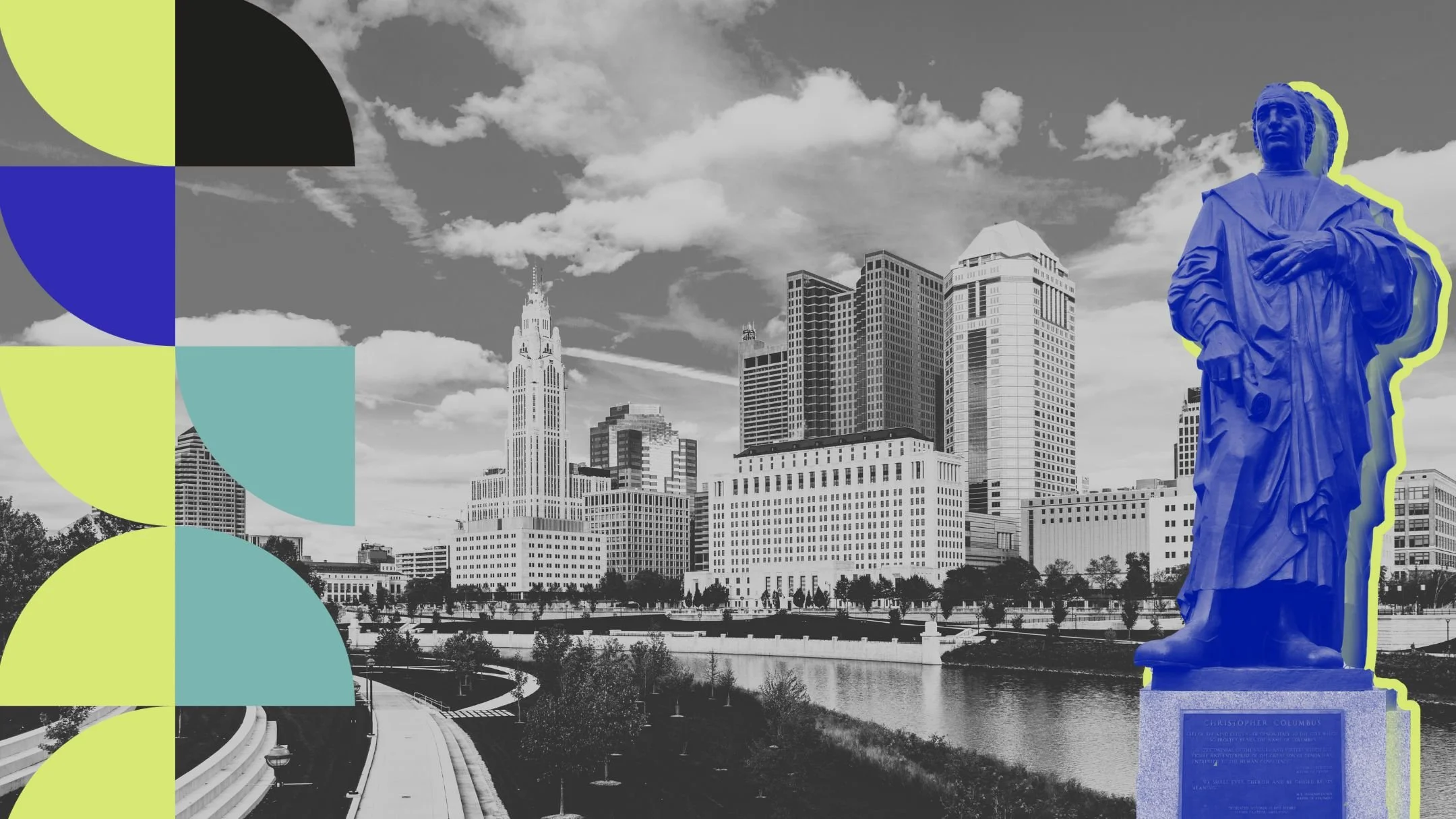
In the turbulent summer of 2020, when protests erupted over police brutality against people of color and controversial statues were being toppled and defaced nationwide, the City of Columbus preemptively removed its Christopher Columbus statue from the steps of City Hall. With the statue in storage, the City of Columbus partnered with Designing Local in 2023 to seek funding from the Mellon Foundation for “Reimagining Columbus,” a 2-year research, community engagement, and design process to reckon with the statue and imagine a future in which truths about its subject are more accurately conveyed. The proposal was awarded $2 million and Designing Local was tasked with managing the project.
HOW
Designing Local managed a multi-disciplinary team to undertake the following:
RESEARCH & LEARNING. In order to confidently recommend a course of action regarding the City of Columbus’ Christopher Columbus statue, the Reimagining Columbus project team felt it was important to be grounded in truths about the explorer and his legacies, particularly those within Columbus, Ohio. Learnings from subject matter experts, museums and site tours, original research, community conversations, and arts and culture colleagues nationwide were used to educate the public and inform project deliverables.
COMMUNITY ENGAGEMENT. In recognition that conversations about the Columbus statue would challenge participants — particularly those from the city’s Indigenous, Italian-American, and Black communities — the Reimagining Columbus engagement team planned a process that would accommodate their emotions about it but also forge a collective path forward. The team’s approach to this conversation utilized a customized, emotional safety–oriented methodology centered on Sankofa, the Ghanan idea that progress requires applying lessons from the past, to encourage more courageous sharing and evoke personal histories that could be influencing present-day perceptions. Large group and affinity group conversations, community events, and written feedback were employed in various ways throughout the process.
DESIGN. The project’s design team worked to translate the learnings from research and community engagement into a design concept for a possible new Christopher Columbus statue placement. The team relied on Indigenous design principles to guide their vision for an immersive experience of nature and community togetherness at which visitors could experience the statue (or not), but also learn, play, restore themselves, and heal.
WHAT
Designing Local delivered the following Reimagining Columbus project outcomes:
A website and StoryMap timeline, 2 research papers, 35 videos with more than 20 hours of educational content, and several in-person community learning exchanges provided context regarding Christopher Columbus, the statue of his likeness and public perceptions of it, and the city’s relationship with its namesake.
More than 20 community events and affinity group conversations elicited rich, layered feedback to help inform the design process.
Conceptual designs of a new space in which to display and contextualize the statue, based on Indigenous design principles, translated research and community feedback into physical elements that could tell the story of Columbus — the city and the man — and help all visitors experience emotional safety in the space. So expansive did this vision become that the city, the Reimagining Columbus project team, and community members were inspired to embrace it as a generational vision for an altogether new type of public space in the city.
An art plan for City Hall campus suggested how new art could refresh and enliven this uninspiring civic space and ensure that it celebrates all city residents.
View the Project Outcomes Here
Powell Historic Survey
Powell, Ohio
WHY
Powell has a deep appreciation for its history and is proactive in making improvements and advancements in its historic preservation efforts. The City took the initiative to update its Zoning Code, and with that, look into any relevant historic preservation policy or relevant efforts listed in the code. The City anticipates that a historic survey will inform and enhance its preservation policies and initiatives. The primary goal of this survey was to determine if the project area could be designated as a historic district. Another goal was to create practical policy recommendations for the City.
HOW
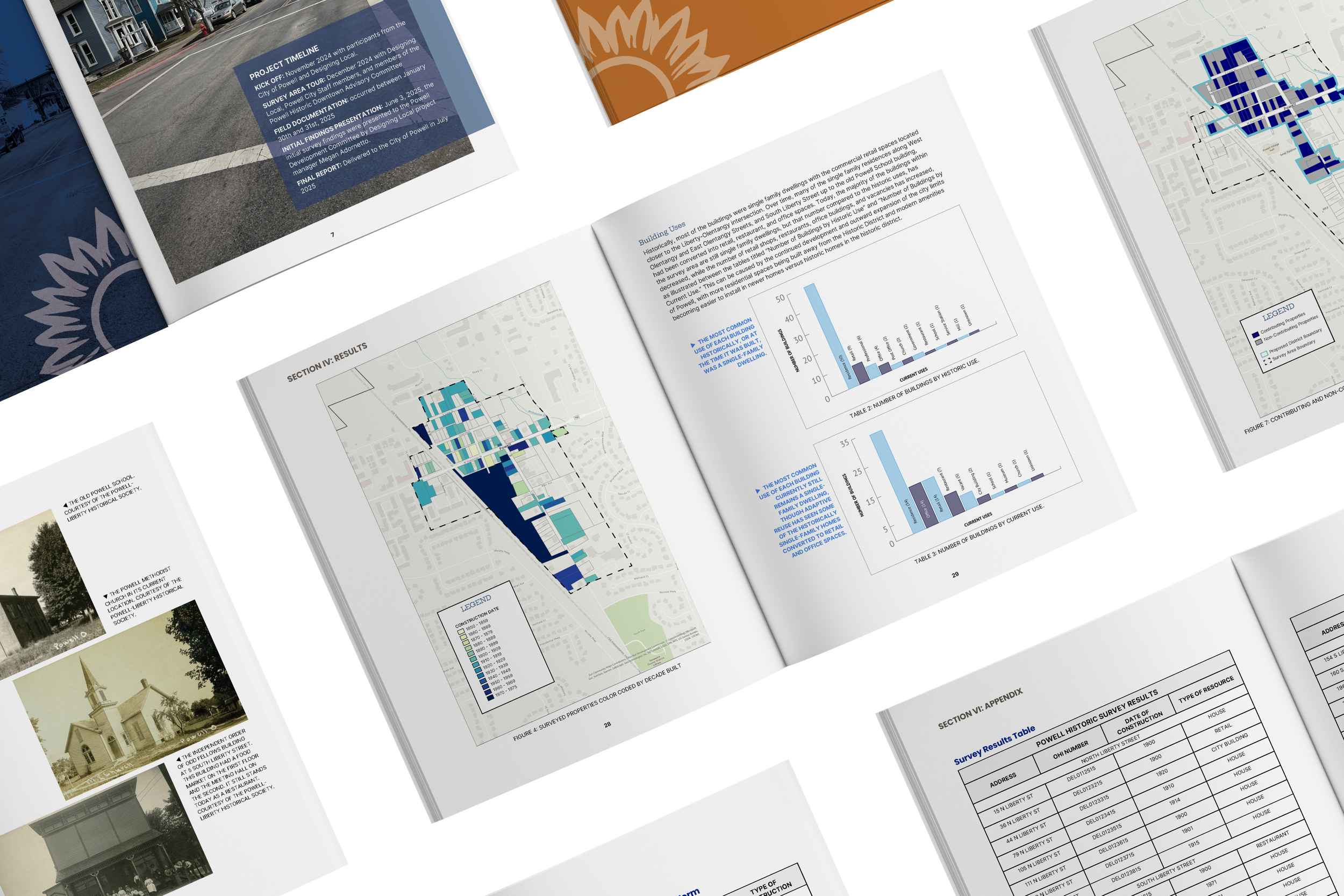
Designing Local evaluated 80 properties within the Historic Downtown Powell area to determine eligibility for designation as a historic district. The survey, completed in January 2025, documented properties built before 1975, focusing on their historical significance, architectural styles, and integrity.
WHAT
The survey identified a mix of residential, commercial, and institutional buildings, with most structures being vernacular in style and dating from 1859 to 1973. Recommendations include creating a local historic district, writing a preservation ordinance, establishing a local historic register, and becoming a Certified Local Government to access funding opportunities like tax credits and grants. The survey emphasized the importance of community engagement and education in advancing historic preservation goals while proposing boundaries for a new historic district to protect Powell’s cultural heritage.
Toledo Old West End Historic District Design Guidelines
Toledo, Ohio
WHY
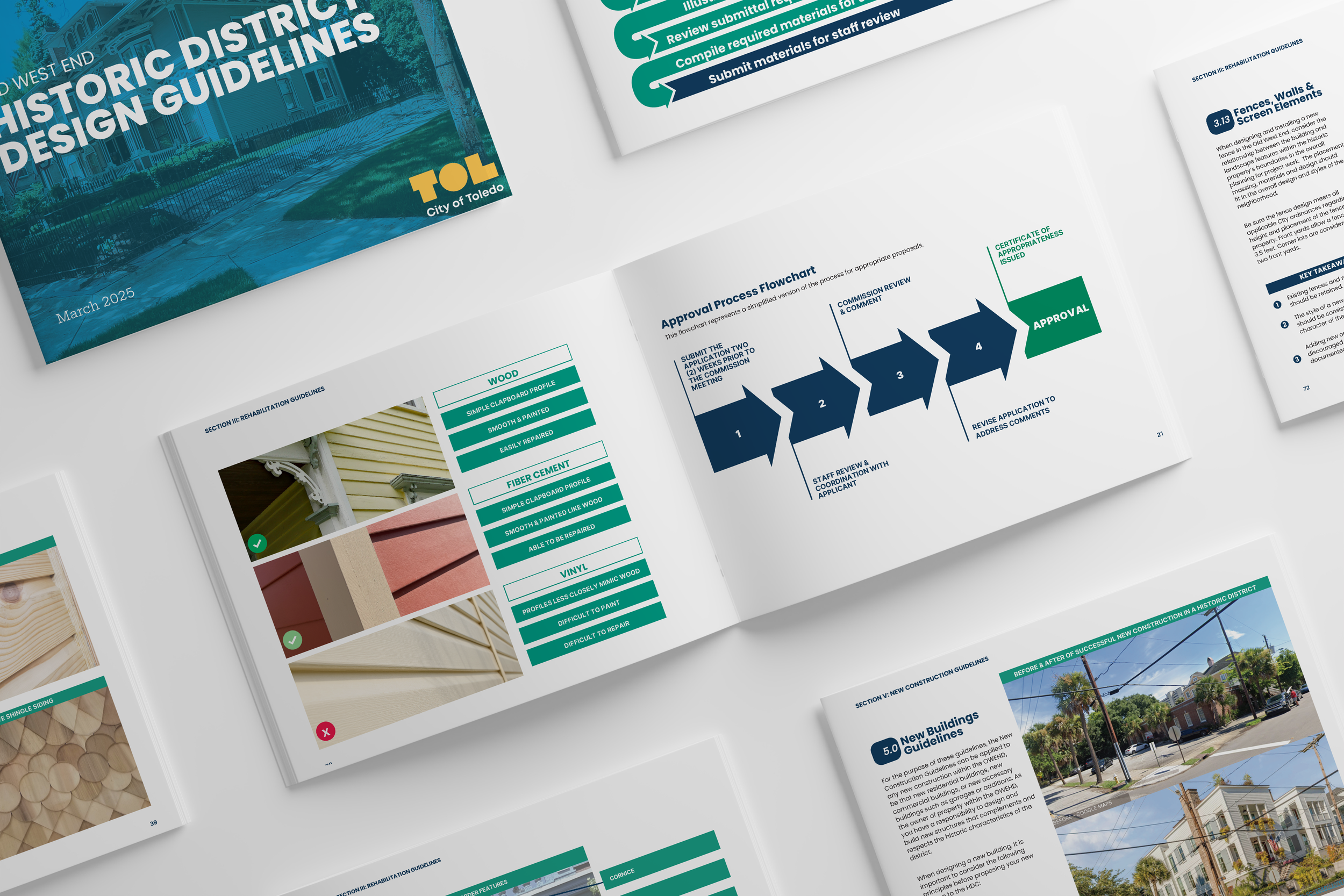
These guidelines were developed to provide a more comprehensive and localized set of standards for the Old West End Historic District (OWE). While still based on the national Secretary of the Interior’s Standards for Rehabilitation, they incorporate specific guidance relevant to the unique characteristics of the OWE.
HOW
The process involved several steps: a kick-off tour and photography of the district for information gathering; bi-weekly coordination with City of Toledo staff and the Historic District Commission; conducting one-on-one discussions with diverse community stakeholders, including property owners, residents, the Lucas County Land Bank, and commission members, to understand existing regulations and preservation issues; and holding a public open house to allow residents to review the draft guidelines and provide feedback, which was then incorporated.
WHAT
Ultimately, this comprehensive assessment empowers the community to make informed decisions about the future preservation and revitalization of this treasured historic district.
Amherst Historic District Design Guidelines
Amherst, New Hampshire
WHY
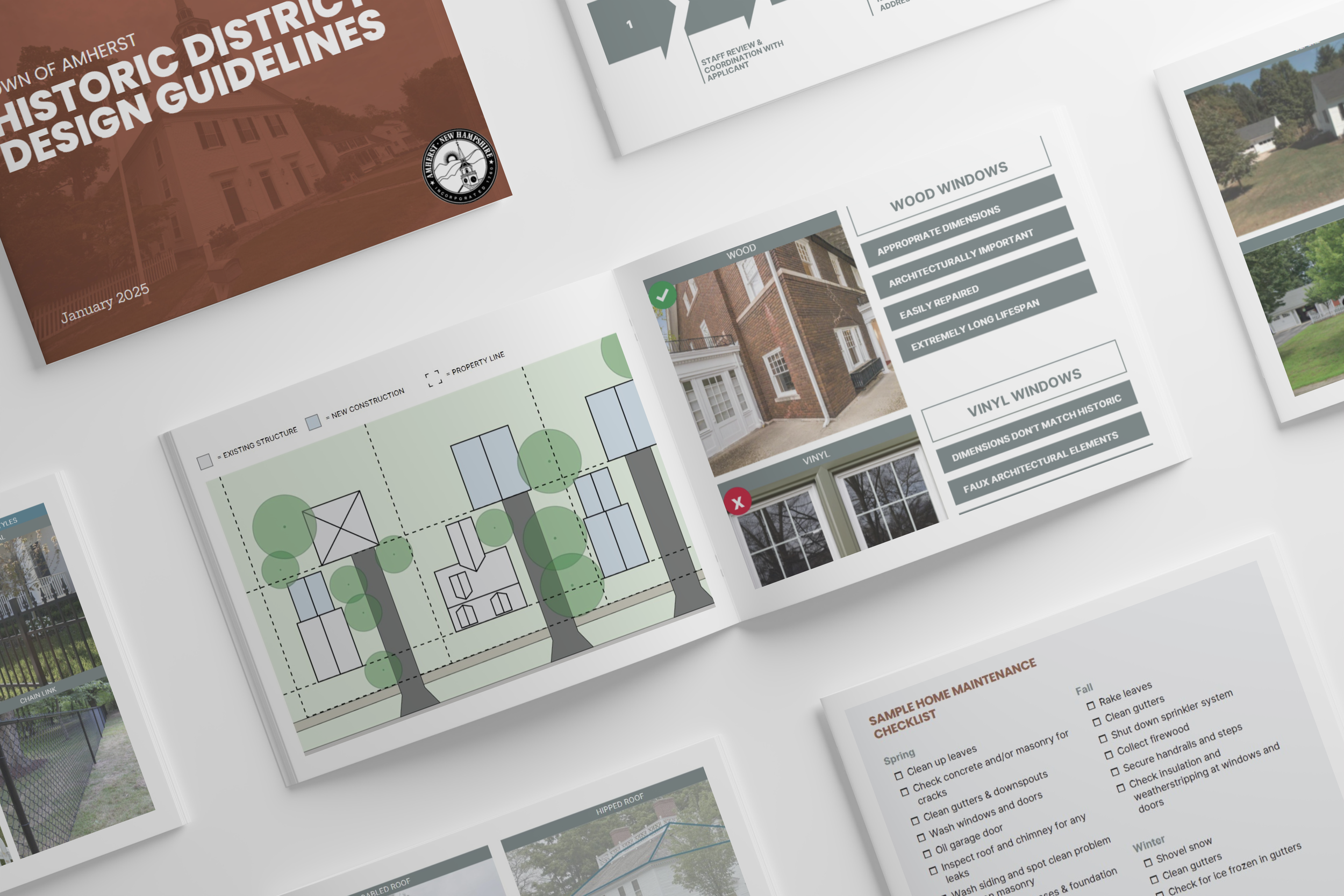
These guidelines were created to provide clear direction for exterior work on historic buildings within the Amherst Village Historic District. The primary goal was to transition the existing, mostly textual guidelines into a visual document as well as to ensure that the guidelines were more easily digestible for everyday homeowners.
HOW
This project was a collaborative effort, supported by the Town of Amherst and the Amherst Village Historic District Commission, with partial funding from a Certified Local Government (CLG) grant.
WHAT
The final result was a comprehensive, practical resource that uses easy-to-read graphics and illustrations to describe historical context, prominent architectural styles, and specific instructions for various building elements. This ensures all new work is sensitive to the village's historic fabric, preserving its unique character and appearance.
Somerset Historic District Building Assessment
Somerset, Ohio
WHY
As a cornerstone of the community, Somerset’s historic district holds immense cultural and aesthetic value. The assessment report offers a captivating journey through time, revealing the stories embedded within its structures and will be a crucial step to preserve the unique character and rich history of Somerset.
HOW
By meticulously documenting the district’s buildings, the Designing Local team worked to develop a comprehensive review of the architectural gems nestled within this 170-acre area. From identifying significant architectural features to assessing the condition of each building, the report provides a detailed snapshot of the district’s current state. By uncovering the historical context of these structures, the report contributes to a deeper understanding and appreciation of Somerset’s past.
WHAT
Ultimately, this comprehensive assessment empowers the community to make informed decisions about the future preservation and revitalization of this treasured historic district.