Brunswick Parks & Recreation Master Plan
Brunswick, Ohio
WHY
When the City of Brunswick, Ohio emerged from a period of financial hardship to resume investing in community amenities, fiscally conservative city leaders wanted to ensure these investments would target their constituents' highest priorities. Their goal with the city's first-ever Parks & Recreation Master Plan was to understand what community members wanted from their parks system and develop a responsible, measured approach to delivering it.
HOW
To ascertain Brunswick residents' parks-related needs and preferences, Designing Local conducted 17 stakeholder interviews, held 2 open house events, and offered an online survey to which almost 1,400 responded. Zec Eight Insights was enlisted in the planning process to conduct a benchmarking analysis that compared Brunswick's parks system with others of a similar size nationwide; Envision Group prepared a fiscal analysis and implementation plan to facilitate each recommendation.
WHAT
Brunswick's City Council discussed the plan in early 2025; at the same meeting, they recommended dedicating $1.2 million from the city budget to implement its recommendations.
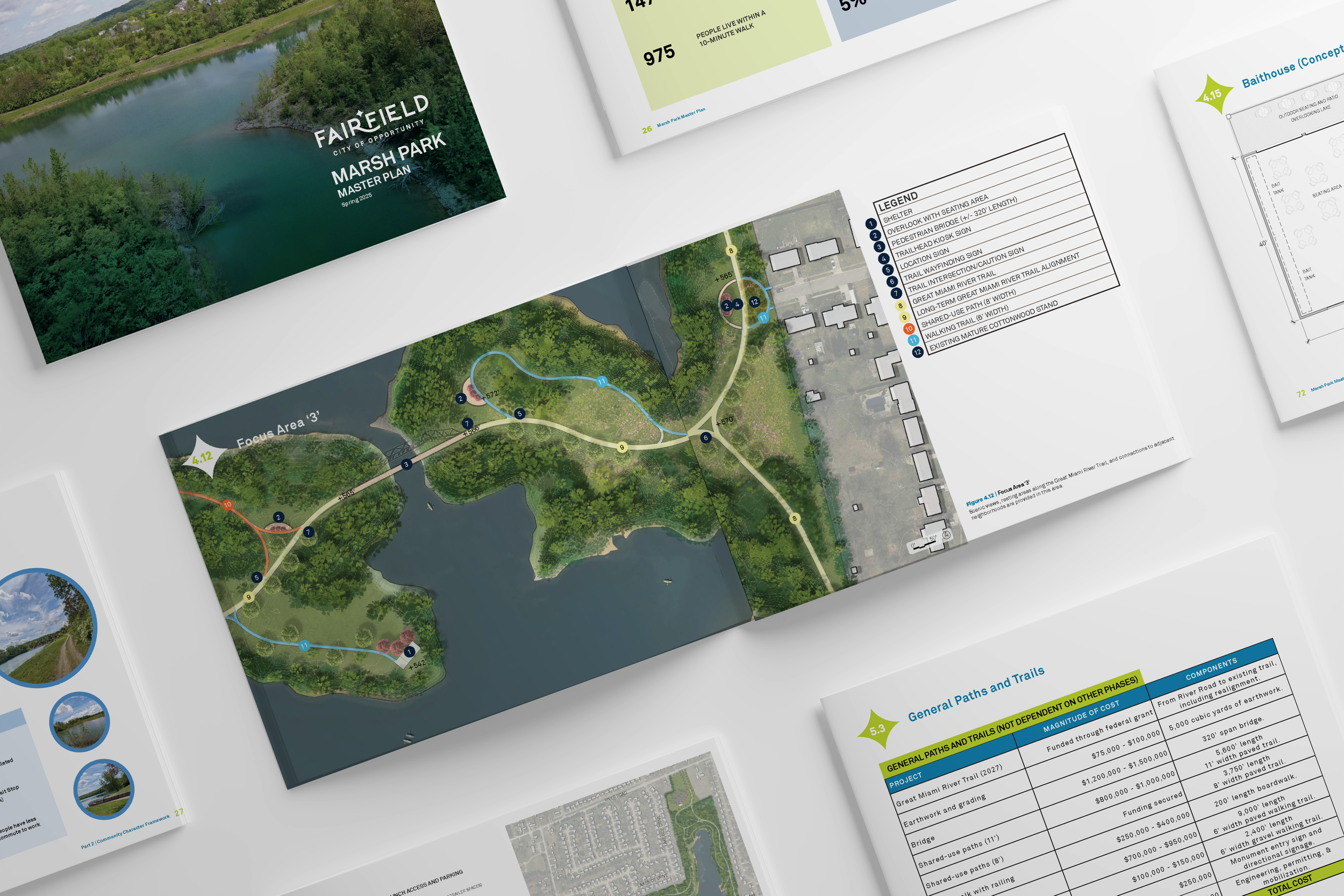
Marsh Park Master Plan
Fairfield, Ohio
WHY
Fairfield, Ohio first leased a portion of the Martin Marietta/Dravo Quarry for the Thomas O. Marsh Park property in 1978; since then, the park has grown to be 146 acres, including a 60-acre lake. Marsh Park serves as a crucial recreational area for the community, offering both passive natural elements and outdoor activities. In 2016, the City completed its first Master Plan for the site, which laid the foundation for future development and improvements. Fairfield’s City Council has continued to prioritize Marsh Park as a significant asset for the city, highlighting the property’s intrinsic value, natural beauty, and potential for development.
HOW
Designing Local offered planning solutions and visualizations, grounded in community feedback and technical analysis, that cast a compelling vision for what this park could become — a regional trail hub with expanded uses and access for both community members and trail travelers.
WHAT
In early 2025, Designing Local finalized an updated Marsh Park Master Plan that will further enhance the park’s natural environment, promote connections between the park and its users, foster community through events and programming, and provide access to amenities that encourage recreation.
Rickenbacker Woods Park
Columbus, Ohio
WHY
This project will create site development elements for the Rickenbacker Woods Foundation including various interpretive features and site infrastructure to support events, visitation, and other activities. The ‘Captain Edward V. Rickenbacker House’ is a National Historic Landmark, one of only three in Franklin County (Ohio Statehouse & Ohio Theatre). The site also honors Granville T. Woods, a world renowned African American scientist and inventor. He invented several items which allowed for safer electric railways and other public uses of electrical power. He is a member of the National Inventors Hall of fame.
HOW
The Rickenbacker Woods Foundation strives to ignite the spirit of innovation and perseverance embodied through the lives and legacies of Capt. Eddie Rickenbacker and Granville T. Woods. This new park project will transform an existing site to provide youth access to pathways, play area, interpretive features, landscaping and site elements.
WHAT
The project is currently in design.
Central Ohio Greenways Wayfinding Strategy Guide
Central Ohio
WHY
To accommodate the massive population growth expected in Central Ohio through 2050, the Central Ohio Greenways (COG) Board has committed to adding more than 500 miles of trails to its network. The Board has invested in professionally designed wayfinding signs and brand standards, but recognized a need to go further with its wayfinding strategy as it welcomes an influx of newcomers to the trails.
HOW
The COG Board selected for this project a segment of the Ohio to Erie Trail that runs through Madison County, Franklin County, Delaware County, and Knox County in Central Ohio. The intention is that the wayfinding strategy developed for this trail segment will be employed throughout the COG network and serve as a model for regional trail wayfinding across Ohio.
WHAT
The Central Ohio Greenways Wayfinding Strategy Guide will honor the wayfinding investments communities have already made and provide additional strategies to make Central Ohio’s trails as easy to navigate as our roadways.
Fort Wayne 5-Year Parks & Recreation Master Plan
Fort Wayne, Indiana
WHY
The Indiana Department of Natural Resources (IDNR) requires park departments to produce a master plan every five years in order to be eligible for various grants and other funding resources. IDNR requires numerous elements to be a part of an approved report. This includes natural and landscape features, historical and cultural elements, social and economic factors, a supply analysis, ADA accessibility, public participation, and a needs analysis.
HOW
Designing Local and its partner Zec Eight Insights developed a master plan for Fort Wayne along with project partners New Haven-Adams Twp Parks & Recreation and Allen County Parks. The scope for all three projects includes stakeholder and public engagement, an overall park system assessment, and an inventory of each park. The final plan document for each park district is a cohesive document which communicates the current park system, the IDNR-required content, and the strategic implementation of the capital improvements over the next five years.
WHAT
Stakeholder meetings and a public open house were conducted throughout the Fall of 2022. A draft of the plan was submitted to IDNR in January 2023 with and the final plan was completed in May 2023.
New Haven- Adams Township 2023-2027 Parks & Recreation Master Plan
New Haven-Adams Township, Indiana
WHY
The Indiana Department of Natural Resources (IDNR) requires park departments to produce a master plan every five years in order to be eligible for various grants and other funding resources. IDNR requires numerous elements to be a part of an approved report. This includes natural and landscape features, historical and cultural elements, social and economic factors, a supply analysis, ADA accessibility, public participation, and a needs analysis.
HOW
Designing Local and its partner Zec Eight Insights developed a master plan for Fort Wayne along with project partners New Haven-Adams Twp Parks & Recreation and Allen County Parks. The scope for all three projects includes stakeholder and public engagement, an overall park system assessment, and an inventory of each park. The final plan document for each park district is a cohesive document which communicates the current park system, the IDNR-required content, and the strategic implementation of the capital improvements over the next five years.
WHAT
Stakeholder meetings and a public open house were conducted throughout the Fall of 2022. A draft of the plan was submitted to IDNR in January 2023 with and the final plan was completed in May 2023.
Allen County Parks 2023-2027 Parks & Recreation Master Plan
Allen County, Indiana
WHY
The Indiana Department of Natural Resources (IDNR) requires park departments to produce a master plan every five years in order to be eligible for various grants and other funding resources. IDNR requires numerous elements to be a part of an approved report. This includes natural and landscape features, historical and cultural elements, social and economic factors, a supply analysis, ADA accessibility, public participation, and a needs analysis.
HOW
Designing Local and its partner Zec Eight Insights developed a master plan for Fort Wayne along with project partners New Haven-Adams Twp Parks & Recreation and Allen County Parks. The scope for all three projects includes stakeholder and public engagement, an overall park system assessment, and an inventory of each park. The final plan document for each park district is a cohesive document which communicates the current park system, the IDNR-required content, and the strategic implementation of the capital improvements over the next five years.
WHAT
Stakeholder meetings and a public open house were conducted throughout the Fall of 2022. A draft of the plan was submitted to IDNR in January 2023 with and the final plan was completed in May 2023.
Lockbourne Veterans Park
Lockbourne, Ohio
WHY
Lockbourne is located south of Columbus and has a charming collection of historic homes and buildings. The Village is taking steps to capitalize on various resources including several canal locks and a major stream corridor.
The Village planned to utilize an open lot adjacent to its Town Hall as a site for a new Town Green that will include a new Veterans Memorial, a performance pavilion, plantings, and various amenities. The Town Green will become the focal point of future community events.
HOW
Designing Local worked with Village leadership to develop a working concept which was used to solicit feedback from various community stakeholders. Adjustments to the original concept were made and multiple variations of various design elements were created.
In addition, the plan included an integrated plan for phasing. The Veterans’ Memorial were constructed first and the remaining elements were constructed when funds become available. The plan allows for the Town Green to function with only some elements complete or as a fully realized plan.
WHAT
The park had its grand opening on November 10, 2021, and included a substantial Veterans Day celebration. The park will be utilized for both Memorial Day and Veterans Day celebrations going forward.
Tuttle Park Lower Field Improvements
Columbus, Ohio
WHY
Tuttle Park is located just to the north of the Ohio State University Campus. The existing park includes several baseball fields, a basketball court, and a shelter that are underutilized and deteriorating. The City of Columbus desires to renovate the park to include uses which will be more effectively utilized by neighborhood residents. New uses will include a skatepark, shelter, event lawn, and dedicated cricket field. The goal is to encourage a sense of ownership through the addition of amenities which are more fitting of area demographics. Additionally, the park includes several historic and public art elements and the City desires to utilize these elements as inspiration for a signage and wayfinding system.
HOW
Designing Local is leading this project with a group of sub-consultants that includes environmental graphic designers, civil, structural and electrical engineers, and a skatepark designer. Designing Local facilitated several public workshops and the results has informed the final design program and various design elements of the park. The skatepark portion of the project scope includes a strategy to deliver the project through a design/build bidding mechanism.
WHAT
Technical design for the project is complete and the project is now in the construction stage. The park opened in fall 2021.
RECOGNITION
2024 ASLA Honor Award, Design-Constructed
Cape May County Creative Placemaking Plan
Cape May, New Jersey
WHY
In 1989, Cape May County initiated a taxpayer-funded program to purchase or protect open space and farmland throughout the County. The program proved successful and was eventually expanded to include funding of parks, recreational amenities, and historic preservation projects. While the program has been extremely successful in meeting its mission, it has relatively low public recognition.
HOW
To build awareness of the program and to increase the quality of funded projects, the County initiated a Creative Placemaking Plan which created a brand identity, standards for park design elements and amenities, and a demonstration site design. Designing Local was selected through a competitive process to lead the creative placemaking plan. The team facilitated four total workshops to garner input from key stakeholders and to develop and test ideas.
WHAT
A key part of the process was the creation of a community character framework which defines the unique sense of place present in Cape May County. This was utilized to drive the creation of the brand identity guidelines. The community character framework was also utilized in the design of various signage, site amenity, and architectural concepts throughout the County.